

4 MIN READ
There’s a certain kind of builder who doesn’t fit neatly into one box. You can’t call them a creative, because they understand corporate systems. You can’t call them corporate, because they build culture. They exist in the space between — and that space is where the most interesting things happen.
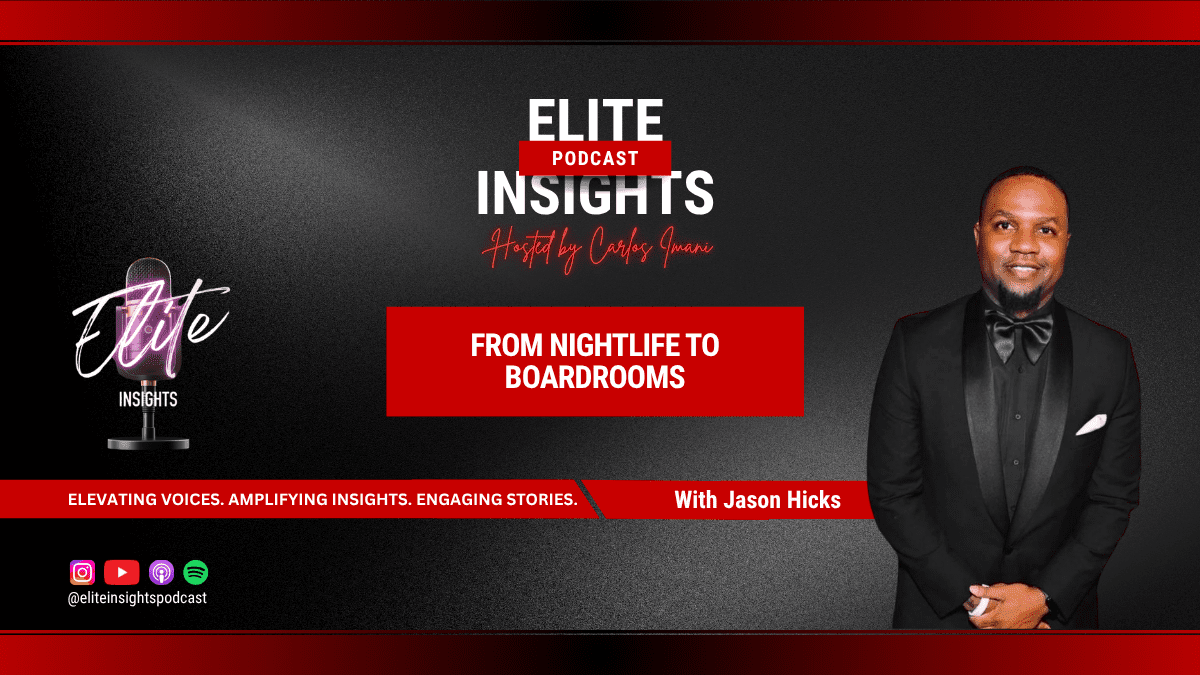
Jason Hicks is that kind of builder. And sitting across from him for Elite Insights, what struck me wasn’t the resume — though the resume is wild. It was the thread that connects every move he’s made. From Atlanta nightlife to Amazon’s corporate strategy team. From producing an Apple TV film to co-owning Blend Coffee and Kicks in Seattle. Every pivot looks random from the outside. From the inside, it’s all the same muscle.
The System Behind the Shine
When people see someone like Jason operating across nightlife, tech, film, and retail, the temptation is to call it hustle. But hustle is what you do when you don’t have a system. What Jason described in our conversation was something more deliberate — a transferable framework for building in any room.
At Amazon, he learned how to operate within massive systems. How to navigate corporate structure, manage stakeholders, and execute at scale. But he didn’t leave his creative instincts at the door. He brought the same energy he’d developed producing events in Atlanta — the ability to read a room, build relationships fast, and create experiences people remember.
That cross-pollination is rare. Most people choose a lane. Jason built a highway that connects them all. And the fuel isn’t talent alone — it’s the discipline to systematize what works in one world and apply it to the next.
Coffee, Kicks, and Community Infrastructure
Blend Coffee and Kicks wasn’t just a business. It was a statement about what community spaces can be when they’re designed with intention. Jason and his partners built a place where sneaker culture, coffee culture, and Seattle’s creative community could collide — not in a corporate way, but in a way that felt like home.
What I took from that part of our conversation is something EC thinks about constantly: physical space is storytelling. The way a room is laid out, what’s on the walls, how people are greeted when they walk in — all of that communicates something about who belongs there. Blend got that right. It wasn’t trying to be everything to everyone. It was specific, intentional, and unapologetically itself.
That’s the same principle we apply to every event and every engagement at EC. Specificity is what makes spaces feel real. Generality is what makes them forgettable.
What Atlanta Taught Seattle
One of the most compelling threads in our conversation was how Jason’s Atlanta roots shaped his Seattle moves. Atlanta has a particular energy around Black entrepreneurship — a boldness, a willingness to bet on yourself, a cultural infrastructure that celebrates building. Jason brought that DNA to a city that operates differently.
Seattle is quieter about its ambition. More corporate. More cautious. And what Jason showed — through every venture from events to film to coffee — is that you don’t have to abandon one city’s energy to succeed in another. You translate it. You bring the boldness but learn the local language.
That translation skill is something EC practices in every client engagement. We work with organizations across different cultures, communities, and contexts. The story has to be authentic to the people it serves — but the systems that deliver it can travel.
What EC Learns From Builders Like Jason
Jason’s story is proof that the most powerful builders aren’t specialists — they’re systems thinkers who happen to be creative. The ability to move between corporate strategy and cultural production, between business ownership and artistic expression, isn’t a contradiction. It’s a competitive advantage.
At EC, we’ve built our entire model around this idea. We’re not just a production company. We’re not just a communications firm. We’re an Impact Architecture™ studio — and that means we think in systems that cross worlds, just like Jason does.
The Invitation
If Jason’s story proves anything, it’s that your path doesn’t have to be linear to be strategic. The thread that connects every move is the same: build systems, tell stories, create spaces where people feel something real.
If your organization has a story that crosses worlds — if your impact is bigger than any one label — the Impact Snapshot™ will help you see the architecture underneath it. Fifteen minutes. No pitch. Just clarity on where your narrative is strong and where it needs structure.
Your story doesn’t have to fit in one box. Let’s build the system that holds all of it.
Carlos Imani is the Executive Producer and Principal of The Elite Collective, Seattle’s leading Impact Architecture™ firm. He hosts Elite Insights, a podcast about community, craft, and the architecture of meaningful work.